
(Santa Fe New Mexican, by Andre Salkin, December 16, 2025)
Kirk Carpenter was the superintendent of the Aztec school district during New Mexico’s most recent school shooting, in which a former student killed two classmates at the high school in 2017.
“Anybody would’ve given anything … to have something like that not happen,” Carpenter said. With mass-violence events rising nationwide, he said, “we need to realize that hope isn’t a strategy.”
Spurred by Carpenter’s advocacy, school district leaders, students and state policymakers convened last month in Albuquerque for the state’s third school safety summit, aimed at sharing best practices around what parents consistently cite as a top concern. Amid growing anxiety over juvenile crime and an influx of state dollars, districts across New Mexico are increasingly turning to advanced technology — including artificial intelligence and weapons detection — as part of that effort.
While the Aztec shooting remains the state’s last tragedy of its kind, concerns about students bringing guns to campus and violence in general have only intensified. What effective school safety looks like, though, remains contested.
In the years after the shooting, Carpenter involved himself with lawmakers’ efforts to develop safer schools. He reached out to a former rival baseball coach and longtime friend — then-State Sen. Howie Morales, now lieutenant governor.
He led Morales and other members of the Legislative Education Study Committee through the site of the tragedy, pointing out where safeguards might have made a difference.
From there, Carpenter urged lawmakers like Morales to create a statewide summit to bring together state leaders in discussing strategies and potential investments to prevent another school district from suffering a fate like his.
“He brought this idea with much passion and much experience,” said Morales, a former educator, “of ‘What if we can create a school safety summit that brings all aspects of safety into one room?’ ”
Carpenter downplayed his own role, pointing instead to allies like Los Lunas Republican Rep. Brian Baca, who last session sponsored a proposal to study creating a centralized school safety entity; the measure died without a committee hearing.
Still, Morales said summit participants were clear that districts want an Office of School Safety to coordinate efforts statewide — particularly as funding increases for safety initiatives like House Bill 450, passed this year, which as part of capital outlay for school district projects included $35 million for safety improvements.
“The state has done a great job of giving schools opportunities for hardening schools,” Carpenter said. “But hardening a school is a piece of the pie. It’s not the pie.”
“More than ever before in today’s society, we have to teach each other how to be more human again,” he added. “It’s not a knock on technology … but our kids rely on us.”
Tech could help deter guns
The balance between security and preserving a welcoming learning environment emerged repeatedly at the summit, Morales said, especially from students, who “talked about kindness, communication, awareness,” and about having trusted adults they could report concerns to.
While that can include investments in counselors and wellness spaces, Morales said prioritizing the human element “doesn’t cost anything” yet can have an outsize impact.
“We want to make sure schools feel like a safe, homelike environment — not an institution fenced or chained off.”
Still, Morales said safety technology remains an important tool in addressing a hot topic among state lawmakers in recent years — crimes committed by minors.
“With the rise in juvenile crime — and the governor has been very much a champion on this — we recognize the importance of proactive measures,” he said.
He pointed to Albuquerque Public Schools, the state’s largest school district and one plagued by incidents of students bringing firearms to school, with the Albuquerque Journal reporting the district seized its 10th gun this school year from a student in November.
Albuquerque schools have responded with new investments in security technology. Last month, the district’s board accepted $4.1 million in state capital outlay expressly for that purpose.
“We have heard from the community that they want us to invest in additional safety measures,” district spokesperson Martin Salazar wrote in an email, adding the investments include plans to upgrade the district camera systems, implement a panic alert system and begin rolling out weapons detectors at select schools and stadiums.
While “these projects aren’t set in stone,” Salazar said, the district has reviewed weapons detection systems capable of detecting weapons concealed in objects like metal water bottles, according to an October news release.
Metal detector debate
Santa Fe schools have had the same discussions — and scares.
In December, two Capital High students were arrested after police responded to what they described as a social media “threat” showing one student holding a firearm in a school bathroom. A month later, another Capital High student was charged by Santa Fe police and accused of bringing a knife to school.
Santa Fe parents renewed calls for additional security, suggesting metal detectors and artificial intelligence in camera systems following a series of gun-related hoaxes in September that locked down multiple campuses. School board leadership pushed back at the time, with Vice President Kate Noble saying such tactics can risk harming students psychologically.
“It does do a lot to impact students as they come through a metal detector each day,” Noble said, adding that in her eight years on the board, there has “never been a huge appetite” for them.
But that may be changing.
Deputy Superintendent of Operations Neal Weaver said the district is “exploring all options,” including metal detectors and AI camera systems. He recently visited V. Sue Cleveland High School in Rio Rancho, one of the highest-enrolled schools in the state, to observe its weapons detection system.
But Weaver said the system — which uses sensors and artificial intelligence to detect concealed weapons — may not be a good fit for Santa Fe, citing what he was told by Rio Rancho staff were intensive staffing demands and “false positives.” He also noted such systems work best on campuses with fewer entry points, making it more feasible for Capital High than for an open campus like Santa Fe High School.
For now, he said, Santa Fe’s immediate priorities include fencing projects and converting analog cameras to digital systems. The district, he said, is also considering third-party monitoring services that link directly to its camera network.
‘Eyes can’t be everywhere’
One such company is ZeroEyes. A spokesperson for the company said it works with 10 New Mexico districts, including in Silver City and Hobbs.
Founded after the 2018 Parkland, Fla., high school shooting, ZeroEyes uses AI to detect visible firearms in camera feeds “before shots are fired so we can get law enforcement there,” co-founder Sam Alaimo, a former Navy SEAL, told The New Mexican.
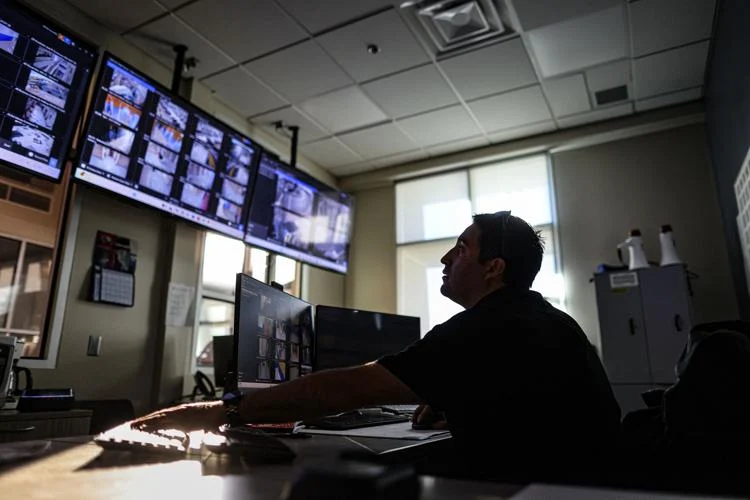
When the software flags a possible weapon, it sends an image to be reviewed by analysts at monitoring centers in Hawaii and Pennsylvania, who sort through false positives to dispatch law enforcement and alert locals to the sighting.
“Every single person in that room is either military and/or law enforcement. Very calm under pressure — very good identifying guns,” said Alaimo, who noted the firm has thousands of commercial and government partners.
“What made us really good on a Navy base or in a subway platform or in a grocery store made us even better in a school,” Alaimo said.
Hobbs Municipal Schools adopted ZeroEyes six years ago, integrating it into the more than 1,000 cameras across its 19 campuses. Superintendent Gene Strickland said the move was part of a broader “ecosystem” of safety that also includes closer coordination with law enforcement and a new, dedicated director of safety and security position.
Physical considerations followed: restricted keycard access to campus buildings, ballistic window film and evaluations of weapons detectors, which Strickland said ultimately weren’t “a realistic fit” for the district.
“We want folks to respond, not react,” he said, warning against “knee-jerk reactions that oftentimes lead to greater harm.”
But even with the security upgrades he noted as worthwhile investments, Strickland echoed a message shared by others that “the most effective” tool in the district is the “human-to-human piece.”
“Our greatest single asset in prevention is our relationships and our people,” he said. “We also know our eyes can’t be everywhere.”
School safety threats and concerns statewide, including in Santa Fe, can be reported through the “See Something, Say Something” anonymous tip system.
This story has been amended to reflect the following correction. A previous version of this story incorrectly identified Sam Alaimo as Chris Alaimo.
###